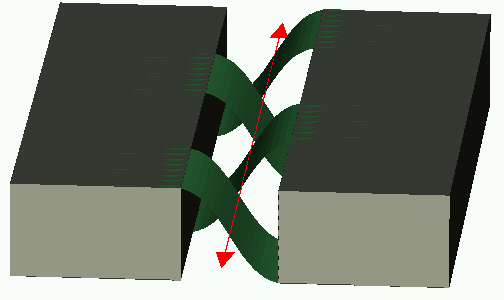
Hinges, as many of us think of them, tend to have some degree of slop and stiction/friction. In terms of mirror cells this means that your mirror may not be perfectly balanced on all support points. For smaller mirrors this may not be critical, but for larger, thinner mirrors this can be the difference between a well performing mirror, and one that delivers visibly astigmatic images at the eyepiece.
Compliant (bending) hinges can offer much less slop and friction. There are different ways to make compliant hinges.
Here are several views of a compliant cross hinge, using sheet
metal as the hinge material. The double headed arrow represents
the axis of rotation of the hinge.

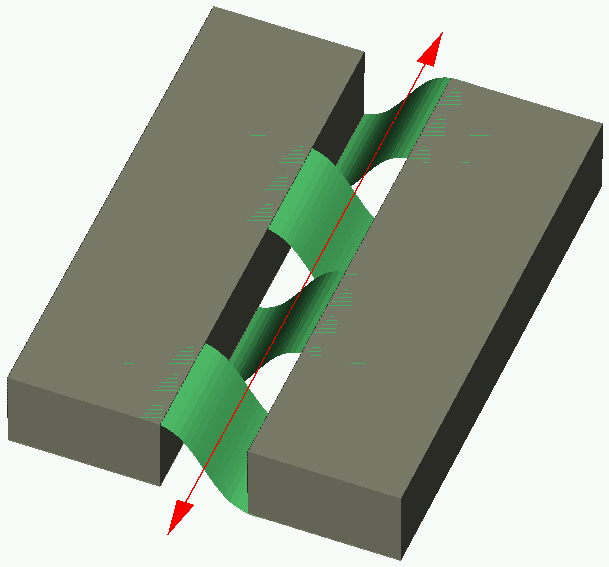
However, Don Clement mentions that this can be improved. Make the hinge 'foundation' with 45 degree bevels. This allows the sheet metal to be straight/unstressed when the hinge is in the neutral position, and allows use of shorter (therefore stiffer) sections of sheet metal. This higher stiffness especially helps to keep the axis of rotation strictly defined, even when the hinge is subject to loads and forces from unexpected directions.
Also, Don recommends that you refer to the following books:
- "Precision Machine Design" by Alexander Slocum
- "Engineering Metrology" by K.J. Hume.

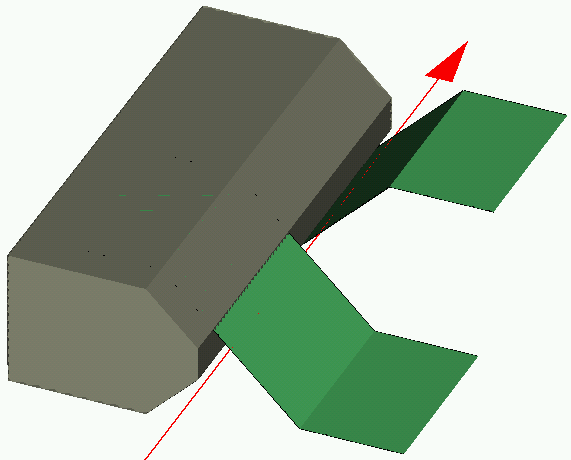
Another way to make compliant hinges is to use a viscoelastic substance, such as RTV silicone. In US patent 5,877,905 by Richard Schwartz, he proposes using the 'pads' of RTV silicone (that bond mirror and mirror cell components together) as the compliant hinges. This approach has great appeal, especially considering that 'fabrication' of this compliant hinge is merely squirting RTV silicone in between the various mirror cell elements. I will probably experiement with this approach and see if it can meet my needs. Why? It's so easy and inexpensive to study this method, that I would be a fool to pass it up.
Advice from Richard on using RTV silicone: "To get good bonding...clean the glass and the aluminum parts with acetone where they are to be bonded with silicone. Wash your fingertip with acetone to degrease it. Use your finger to smear a thin film of silicone where the pads will be formed."
Want to look up Richard's patent? Go here, and type 5,877,905 in the search box (make sure you include the comma's too).
Have ATM's actually used compliant hinges in mirror cells? Yes! As Craig Edmonds pointed out, Frédéric Géa's has applied flexural pivots to hybrid astatic lever mirror cell support systems in several of his telescopes. See: http://astrosurf.com/altaz/chrysocallevers.htm and http://astrosurf.com/altaz/index_e.htm
Also, Craig and Don both point out that several aerospace companies make flexural pivot assemblies, such as http://www.lucasutica.com/pivots/
Finally, Craig points out an article which outlines the qualifications of flexural pivots for use in spacecraft: http://www.engineering.usu.edu/mae/faculty/stevef/resume/spie2002b.pdf
All feedback is encouraged!
email: t-k-r-a-j-c-i-@-s-a-n-.-o-s-d-.-m-i-l (remove the dashes)
Last update: 13 Jan 2003