I have found free software (GRAPE - Graphic Real-Time Analysis Programs for Engineering) that is very useful for the ATM to analyze structural properties of trusses. Below are some images that help visualize load levels in the truss elements, a summary table at the bottom to compare various truss arrangements an ATM may consider using...and some sample truss files to help you get started on your own truss analysis studies! ;-)
Thanks to a tip from Ric Rokosz another source of free analysis software is here - FElt (finite element analysis). Another source of free finite element analysis (FEA) software is here. If you know of other free structural analysis software, please let me know and I'll mention it here. (For this web page I've used GRAPE.) (Want to study more about the concepts behind FEA?...check out these online lecture notes from this college course.)
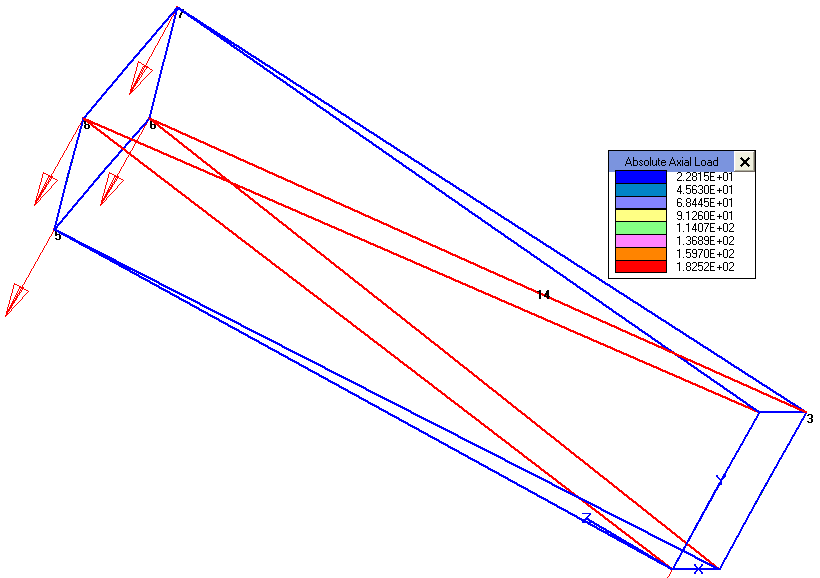
Let's start with the typical eight member truss. As you can
see from the color code/legend in the image (GRAPE does not
distinguish between tension and compression loads in the color
code/legend), only four of the eight truss members are actively
involved in resisting the force of gravity. That should be enough
reason to look at other truss arrangements in an effort to
utilize more of a truss' potential for high stiffness and low
weight. (Also keep an eye on the highest load value (red in the
legend) in each diagram. It's a good indicator of overall
stiffness of the truss arrangement because I used the same load,
same overall dimensions, and the same materials.)
Here is an X-Brace truss. Note that all the truss members (but
some more than others) are now resisting the force of gravity.
Also, the maximum load value in truss members is lower than the
typical eight member ATM truss. 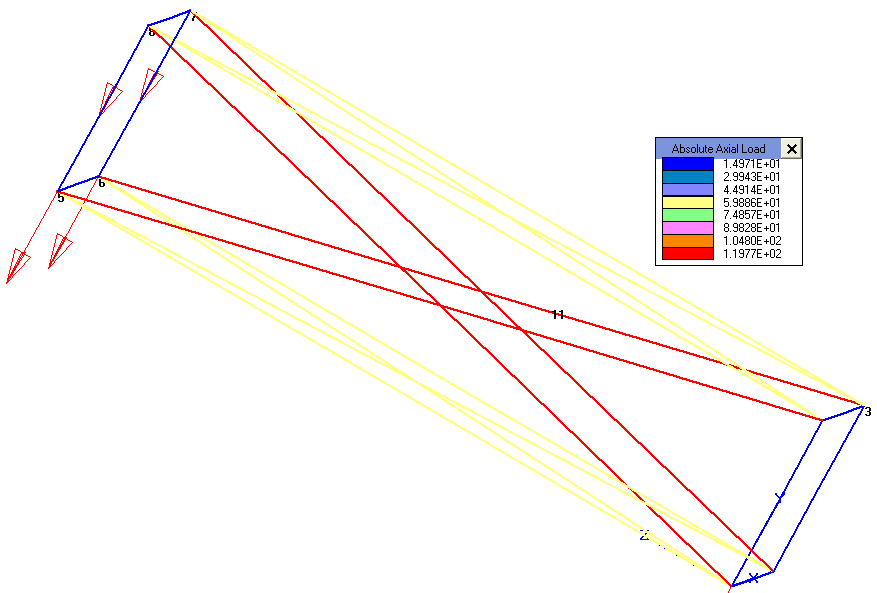
Hey, isn't this the same diagram and X-Brace arrangement as
shown above? Not exactly. I added four more nodes to this
arrangement, specifically at the points where truss members cross
each other. (This means that in the above X-Brace...the long
truss members pass by/through each other without being
connected.) I was curious to see if pinning these truss members
together had any effect on the overall truss stiffness. According
to GRAPE it really makes no difference. (However,
crossed/pinned/shortened truss members should be less vulnerable
from a wind induced vibration standpoint. That remainxs to be
seen, pending some real-word wind tests.) 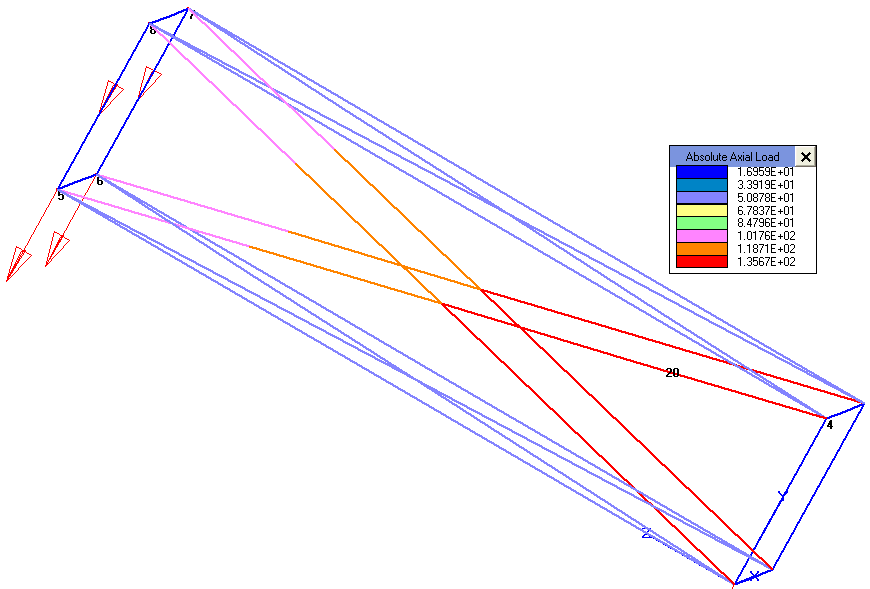
Here is a quad-tripod arrangement. Again, all truss elements
contribute to resisting the force of gravity. However, note the
higher max load value in this diagram, compared to the X-Brace
arrangement above. The quad-tripod uses a narrower angle for its
crossmembers, compared to the X-Brace, and even compared to the
eight member truss. 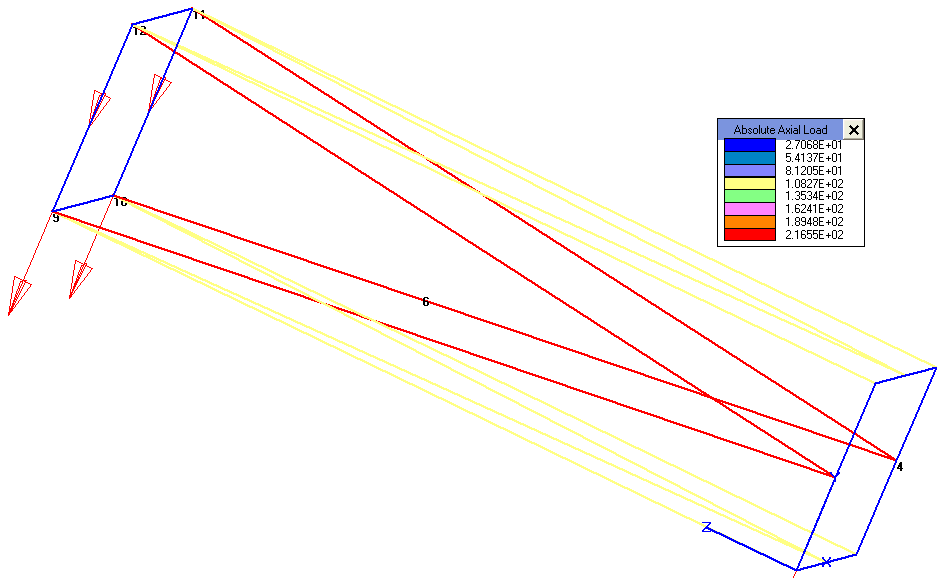
Tired of square truss arrangements yet? Here is a triangular
(six element) truss. Only four of the six elements resist
gravity, but note that these four are all under the same
load...all four are 'maxed out.' But also note that the upper
ring's elements (triangle in this case) are under a slight
load...which is different from all other truss arrangements shown
on this page. 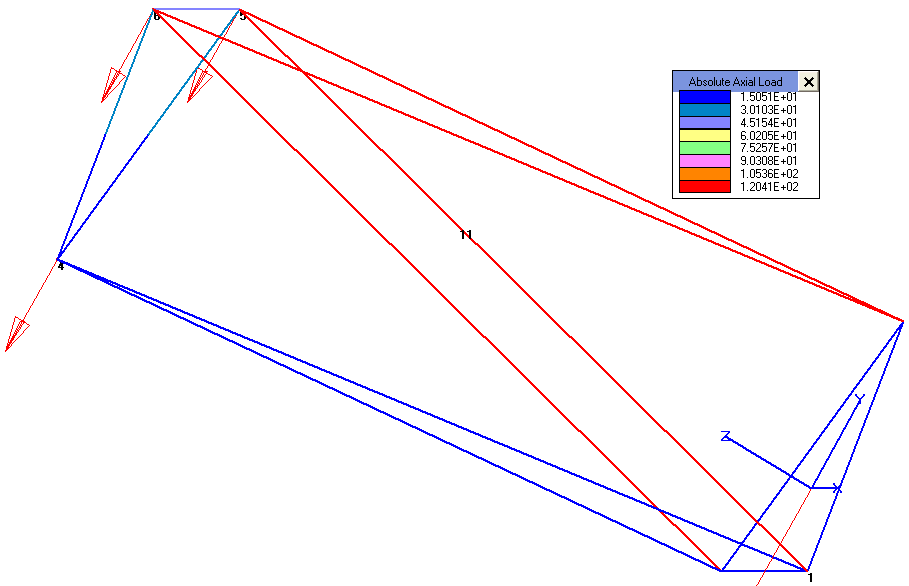
Here is a triangular X-Brace truss. All truss elements are
resisting gravity. 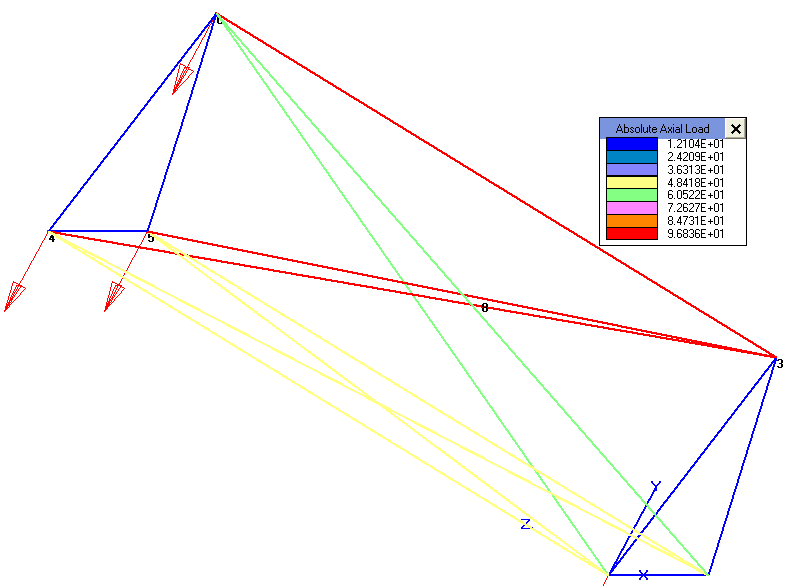
Out of curiosity I analyzed a square-double-X-Brace. All truss
elements resist gravity, however the elements in the upper half
have a lower max load than the elements in the lower half. It
might be worthwhile investigating further optimizing of this
arrangement by using thicker truss elements in the lower half and
thinner elements in the upper half. This would help lower the
balance point slightly, and improve stiffness to weight ratio. 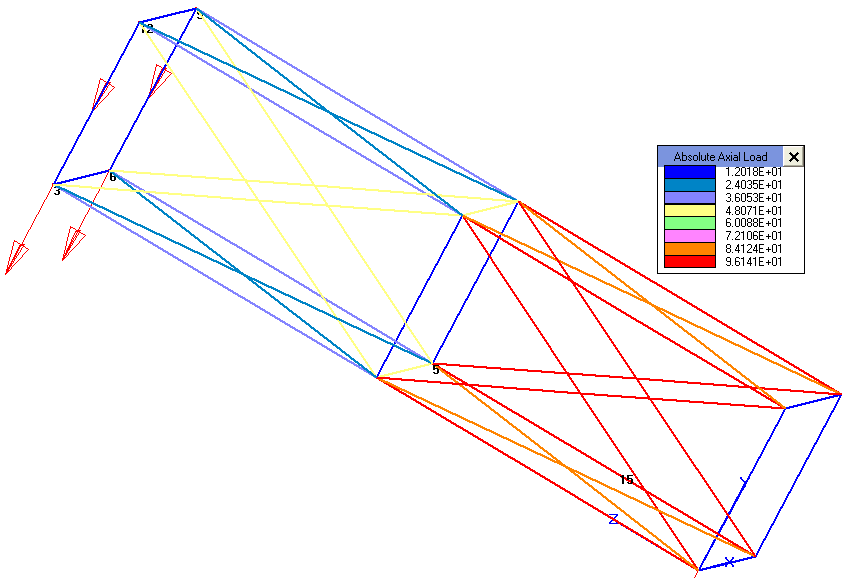
Thanks to comments from Roy Diffrient, I need to show that the above triangular trusses are not very compact...and that more compact (but less stiff) versions can be made.
Here is a view looking almost straight down a triangular
X-Brace truss. I have added an outline for a sixteen inch mirror
to help visualize sizes and clearance. Yes, this triangular truss
does not interfere with the mirror's light path, but it's rather
wide. Its base/width is a bit over 31 inches! 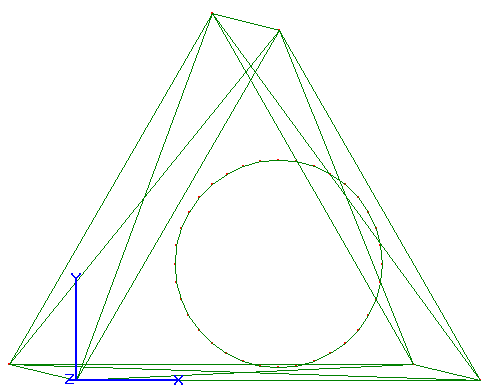
Here is a view looking straight down a triangular (six
element) truss that uses a much more compact arrangement, thanks
to a circular upper ring. (A hexagonal upper ring would also
suffice here to provide enough clearance for the mirror's light
path.) Again, the inner, 'floating' ring represents a sixteen
inch mirror. 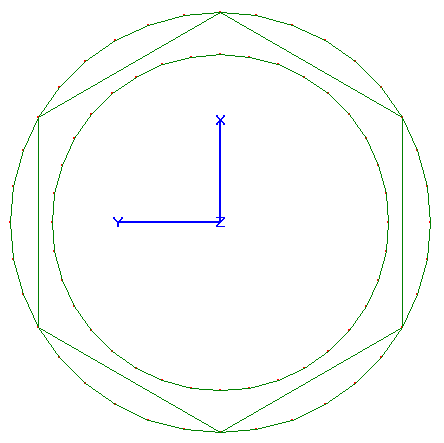
...and here is a slightly different view of this truss
arrangement and mirror placement. See also Jim Miller's 18 inch telescope
with a similar, compact, triangular truss arrangement. 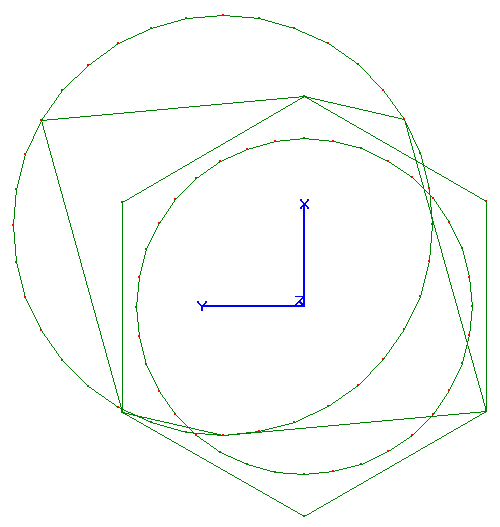
This diagram shows the loading on various truss members, and
its behavior is similar to the first (31 inch wide!) triangular
truss shown above. 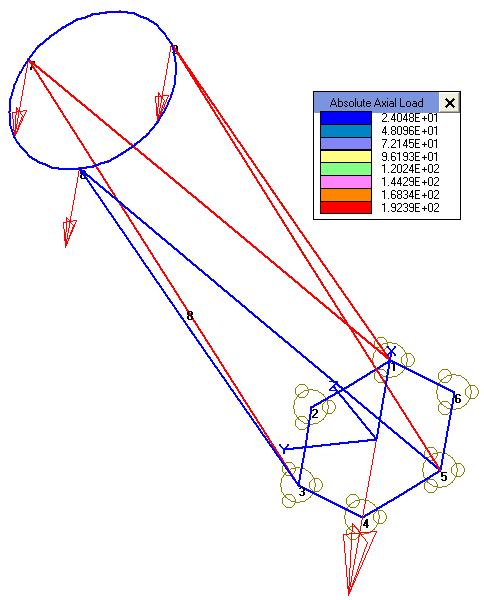
Summary/Comparison Table
For the table below, I used trusses of the same overall length (74 inches), encompassing the same circular mirror size (16 inch diameter), using the same materials (standard 1 inch steel pipe, from the default GRAPE material and geometry databases), and under the same load (40 pounds in the negative Y direction...for triangular trusses I used 13.333 pounds per node...for the square trusses 10 pounds per node.) All trusses were also under the acceleration of gravity, taking into account their own weight. Here is deflection of the upper nodes:
Truss type...............................Deflection (inches)
Triangular (31 inch wide) X-Brace....... 0.0022
Square-double X-Brace................... 0.0026
Triangular (31 inch wide) (6 element)... 0.0036
Square X-Brace.......................... 0.0037
Square 8 element........................ 0.0079
Triangular (17 inch wide) (6 element)... 0.0103
Quad-tripod............................. 0.0137
Note. There are many other factors of comparison that have not been covered here. What about stiffness to weight ratio? Perhaps more importantly...how difficult is it to fabricate some of these truss designs? If you are sloppy in joining truss members at nodes, stiffness can suffer a great deal. A square-double X-Brace or triangular X-Brace may be the stiffest truss of those listed, but it's got the most elements, and/or many locations where 3 or 4 members converge to a node. Do you really want that extra hassle for a little more stiffness? Also, the triangular (6 element) arrangement can be rather stiff...but you need to make it rather wide to achieve higher stiffness. Do you want to make such a wide truss? That will force you to enlarge the rest of your mount to accomodate it.
Hey, the 8 member typical ATM truss is not so good resisting force in the Y direction because only half of the truss elements are able to provide stiffness in this direction. What if you position your load at a 45 degree angle (force acting in both the X and Y directions)...that will require, and allow, all truss elements to resist this load. Good point. I performend such an analysis (I used 7.07 pounds in both the -X and -Y directions on all four upper nodes to give a resultant of 10 pounds at a 45 degree angle for each node.) Result? The same amount of truss deflection in that 45 degree orientation. So...the 8 member typical ATM truss really appears no better or worse with forces acting in different directions on the upper ring. (I am assuming the other truss arrangements also have this similar property...but I have not investigated it.)
One way to improve the stiffness of the typical 8 member truss is to enlarge/widen the base...as recommended by Ken Hunter.
Here is a view looking straight down this 'truncated pyramid'
8 member truss. The base is 1.414 times (the square root of 2)
wider than the original.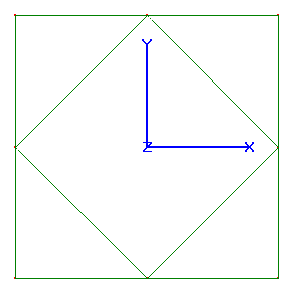
Here is a view of the load diagram. It looks very much like
the original 8 member truss...only 4 of 8 trusses are
contributing to stiffness against the force of gravity and loads
are only slightly decreased. However, when you look at the amount
of truss deflection...it's about 1/2 what it used to be. The
original 8 member truss had a deflection of 0.0079 inches. This
truncated pyramid approach has a deflection of 0.0042 inches. Is
the added stiffness worth the larger truss? Does this truncated
pyramid shaped truss become more difficult for you to connect to
your mount? You have to decide.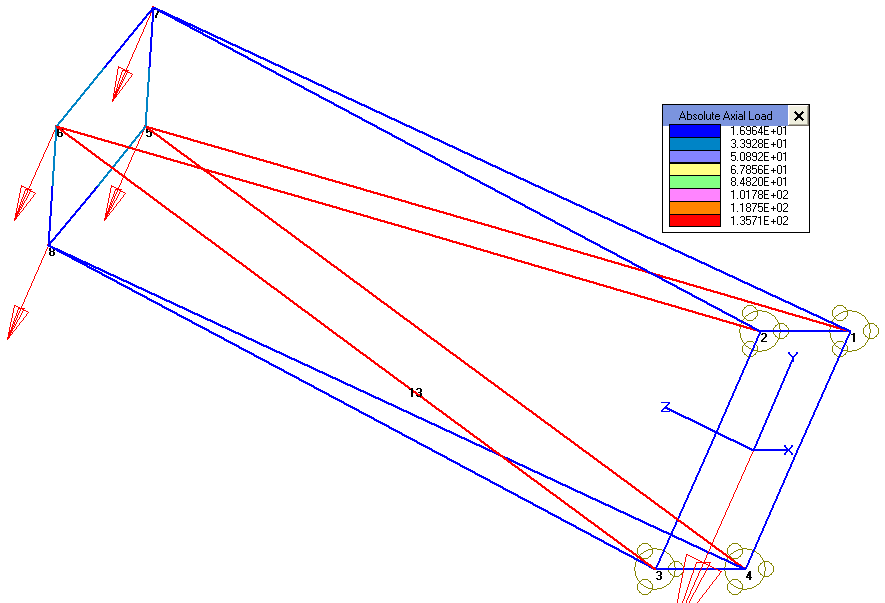
Roy Diffrient points out an important factor in his truss deflection equation...if you change the width/base of the truss...stiffness scales with the square of the width/base. According to results from GRAPE, this rule also apears to apply to the triangular truss arrangements as well.
I hope this information and analysis helps others make wiser design decisions in their next (and hopefully larger! ;-) amateur truss telescope.
Here you can download a .zip file that contains the above truss files I used with GRAPE. Feel free to use them to learn a bit about truss analysis. Please let me know if any errors are present.
You may ask: How do you know GRAPE software is doing a proper job of modelling truss stiffness? Good question. You should never trust software output blindly...always verify! Here's what I did, with some help from Roy Diffrient.
Also, if you want to design your own 8 member truss, here is a warning...this book has some inaccuracies and omissions that may lead you down the wrong path! Section 8.1.1 and section 3.2.2 tell the reader how the stiffness of a single bar or tube increases as the fourth power of the radius. However, no specific equation/rules are given that apply to a truss made of multiple members. Depending on how you read and interpret the material, you may (wrongly) assume that if you merely boost your truss tube diameter by 50%...you truss will be 5.06 times stiffer! Unfortunately that is not the case. As Roy Diffrient points out above, the change in truss tube size changes the cross-section area of the truss member...and that is what changes truss stiffness...but only at the first power, not the fourth.
All feedback is encouraged!
email: t-k-r-a-j-c-i-@-s-a-n-.-o-s-d-.-m-i-l (remove the dashes)
Last update: 31 Dec 2002